01 · The problem
A user’s next choice depends on more than the last click.
Classical recommenders often treat preferences as a static user-item matrix. Sequential models add order, but many predict strictly left-to-right: each interaction can only use what came before it. That is natural at inference time, yet restrictive during training.
The BERT4Rec idea: hide several items inside a known interaction sequence and ask the model to recover them using context on both sides.
This reframing creates more training signals than supervising only the final item and lets every position learn a representation informed by the complete observed sequence.
02 · The mechanism
An encoder stack turns interactions into contextual item representations.
Item + position
Each interaction receives an item embedding and a learned positional embedding.
Multi-head attention
Different heads learn different relationships among positions in the sequence.
Feed-forward transform
GELU layers reshape the contextual representation at each position.
Item probabilities
The masked position is projected back over the item vocabulary.
output = LayerNorm(input + Dropout(Sublayer(input)))The design resembles BERT’s encoder, not a full language-translation Transformer. There is no decoder because the target is an item identity, not a generated sentence. At test time a mask is appended to the user’s history and the model ranks candidate items for that position.
03 · Training objective
Masking is the useful constraint—not a cosmetic borrowing from NLP.
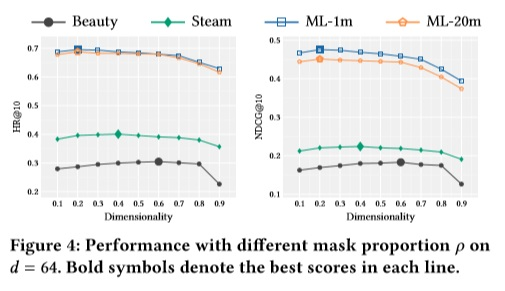
Multiple items are randomly replaced with mask tokens. The model minimizes negative log-likelihood only at those masked positions. The mask proportion therefore controls a real trade-off: too little masking yields fewer learning targets; too much destroys the context needed to infer them.
04 · Evidence in the source study
Four datasets, three ranking metrics, and consistently stronger reported results.
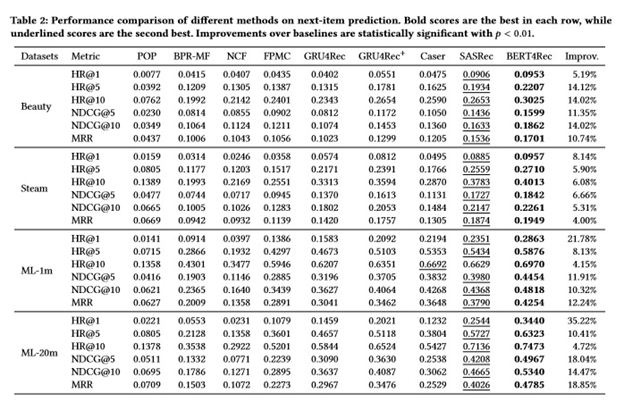
The source paper evaluated MovieLens 1M and 20M, Steam, and Amazon Beauty. For each user, the last interaction was held out for test and the penultimate interaction for validation. Ground-truth items were ranked against 100 sampled negatives using hit rate, mean reciprocal rank, and NDCG.
05 · Reading the results
The study is useful, but it answers a limited question.
The results support the central idea: using context from both sides of a sequence and predicting masked items can produce stronger representations than training only on the final item. They also show that sequence length, data sparsity, mask ratio, and model size cannot be tuned independently.
However, this project reviewed and explained the published experiment; it did not independently reproduce the benchmark. The evaluation ranked each correct item against 100 sampled negatives, which is easier than ranking an entire production catalogue. There was also no online A/B test or analysis of serving latency and cost. The right conclusion is that BERT4Rec was a promising sequential-recommendation approach—not that this report proved it would improve a live recommender.
Credit & provenance
A collaborative report originally published through Aggregate Intellect.
The 2019 workshop report credits Robert Hensley, Madhur Kanjolia, Hari Ravindran, and Tryambak Kaushik. The model-architecture and training-specifics sections were co-written by Robert Hensley and Tryambak Kaushik; other contributions are identified in the archived report. Aggregate Intellect, founded in Toronto in 2018, published the work through its A.I. Socratic Circles (AISC). The original page was later removed, so this edited presentation is hosted here while selected supporting artifacts remain publicly available.